
There’s something rather special about autumn.
The mornings become crisp, the leaves begin to change colour, conkers appear on the ground, and suddenly there are endless opportunities to get outside and explore. For home educating families, autumn can be a particularly lovely season for learning because the world around us becomes our classroom.
And perhaps best of all, autumn learning doesn’t need to involve expensive resources, complicated planning or a Pinterest-perfect activity every day.
A walk through the woods can become a science lesson. Collecting leaves can turn into maths. A rainy afternoon can lead to baking, reading or creative writing. Even the simple act of noticing how the world is changing can spark fascinating questions.
So, if you’re looking for some autumn inspiration, here are some ideas to help you make the most of the season.
Take learning outdoors
Autumn is perfect for getting outside.
You don’t need to plan a formal lesson. Instead, give your children time and space to explore.
Go for a walk and see what you can discover. Look at the trees, listen to the sounds around you, examine the ground beneath your feet and notice how things have changed since summer.
You could ask:
- Which trees have changed colour?
- Why do some leaves fall while others stay on the tree?
- Can you find different types of leaves?
- What animals can you spot?
- What signs of autumn can you see?
- How does the weather feel different?
- What happens to puddles after it rains?
- Can you find evidence that animals have been nearby?
Don’t worry if you don’t know the answers. Not knowing is often where the best learning begins.
Write down questions and look up the answers together when you get home.
Try an autumn scavenger hunt
Create a simple list of things to find:
☐ A red leaf
☐ A yellow leaf
☐ An acorn
☐ A conker
☐ Something soft
☐ Something rough
☐ A feather
☐ A pine cone
☐ A spider web
☐ Something that smells interesting
You can adapt the list depending on your children’s ages.
Younger children might simply enjoy finding the objects, while older children could photograph their discoveries, identify them, research them or create a nature journal.
Turn nature into maths
Autumn gives you countless opportunities for practical maths.
Collect a handful of leaves and sort them by colour, size or shape.
Count conkers.
Make patterns with leaves and acorns.
Measure sticks.
Estimate how many leaves are in a pile before counting them.
Compare the sizes of different leaves.
Older children could record their findings in a table and create a bar chart showing how many of each type of leaf they found.
Suddenly, you’re doing sorting, counting, measuring, estimating, recording and data handling — without sitting down to complete a worksheet.
Explore the science of autumn
Autumn is packed with science.
Why do leaves change colour?
Why do they fall?
Where do insects go when the weather gets colder?
Why do some animals hibernate?
Which animals migrate?
What happens to a leaf when it falls to the ground?
You could choose one question and spend a whole week investigating it.
For example, collect a few different leaves and observe what happens to them over time. Draw them, photograph them or record changes in a notebook.
You could also make a simple decomposition investigation by placing different natural materials somewhere you can observe them safely and checking them regularly.
This is a lovely opportunity to introduce children to observation, prediction and recording — all important scientific skills.
Bring autumn into the kitchen
The kitchen is another brilliant place for learning.
Bake apple crumble, make soup, cook with seasonal vegetables or make some autumn-themed biscuits.
Children can:
- Weigh ingredients
- Measure liquids
- Double or halve quantities
- Read and follow instructions
- Learn about temperature
- Observe how ingredients change
- Talk about where food comes from
- Develop practical independence
And, of course, you get something delicious at the end!
For younger children, cooking can be a fantastic way to practise counting and simple measuring.
For older children, challenge them to adapt a recipe or work out the cost of making it.
Make the most of your local library
Autumn is a lovely excuse to create a cosy reading routine.
Head to the library and look for books about:
🍁 Autumn and changing seasons
🦔 Hedgehogs and other autumn animals
🌳 Trees and forests
🍎 Apples and harvest
🌧️ Weather
🦉 Nocturnal animals
🎃 Halloween and folklore
🌍 Migration and hibernation
You could choose one picture book and use it as the starting point for an entire afternoon.
Read the story.
Talk about the characters.
Draw a favourite scene.
Act it out.
Write an alternative ending.
Research something mentioned in the story.
Or simply curl up together and enjoy it.
Not every book needs to become a lesson. Sometimes reading for pleasure is more than enough.
Get creative with nature
Autumn provides plenty of free craft materials.
Leaves can become pictures, people, animals or decorations.
Sticks can be used to build dens or create temporary sculptures.
Pine cones can become creatures.
You could make an autumn nature collage, create leaf rubbings or paint pictures inspired by the colours you see outside.
For a low-cost activity, take some paper and crayons on your next walk and make bark rubbings from different trees.
Then compare the patterns.
Can you find two trees with similar bark?
Can you describe the textures?
Which one is roughest?
There’s art, sensory exploration, vocabulary and observation all rolled into one.
Don’t let rain stop the fun
Of course, autumn also means rain.
And while there will definitely be days when everyone would rather stay indoors, rainy days can become some of the cosiest home ed days.
Try:
- Puddle jumping
- Rain experiments
- A reading afternoon
- Baking
- Autumn crafts
- Making a playlist of favourite songs
- Board games and puzzles
- Creative writing
- A documentary afternoon
- Building an indoor den
You could even keep a rain gauge and record the rainfall over several weeks, creating your own weather chart.
Start an autumn nature journal
A nature journal can be as simple or elaborate as you like.
All you need is a notebook and a pencil.
Each time you go outside, your child could record:
Date:
Weather:
What I noticed:
What I wondered:
Something I learned:
They might draw a leaf, stick in a photograph, write a paragraph, make a tally chart or simply scribble down a question.
There is no need for perfect handwriting or beautiful illustrations.
The important thing is developing the habit of looking closely and being curious.
Follow their interests
Perhaps your child becomes fascinated by conkers.
Let them investigate conkers.
How do they grow?
Where do they come from?
Why are some bigger than others?
Can they float?
What animals eat them?
Can you find a horse chestnut tree?
Or perhaps they become obsessed with spiders.
Wonderful!
Follow that interest.
Read books about spiders, look for webs, learn about different species, draw one, make a model, write a story about one or investigate how webs are made.
This is one of the joys of home education: learning doesn’t always have to start with a curriculum topic. It can start with a question.
Remember that you don’t have to “do it all”
Autumn can also be a good time to slow down.
There can be a temptation, especially when you see other families sharing their activities online, to feel as though you should be doing more.
You don’t.
Your home education doesn’t need to look like anyone else’s.
One family might spend the day completing nature studies. Another might spend three hours baking. Another might be reading on the sofa. Another might spend most of the week outside.
All of those can contain meaningful learning.
And sometimes the most valuable thing you can give your children is time.
Time to play.
Time to wonder.
Time to explore.
Time to get muddy.
Time to follow a fascination down an unexpected rabbit hole.
Time to simply be children.
A simple autumn home ed challenge
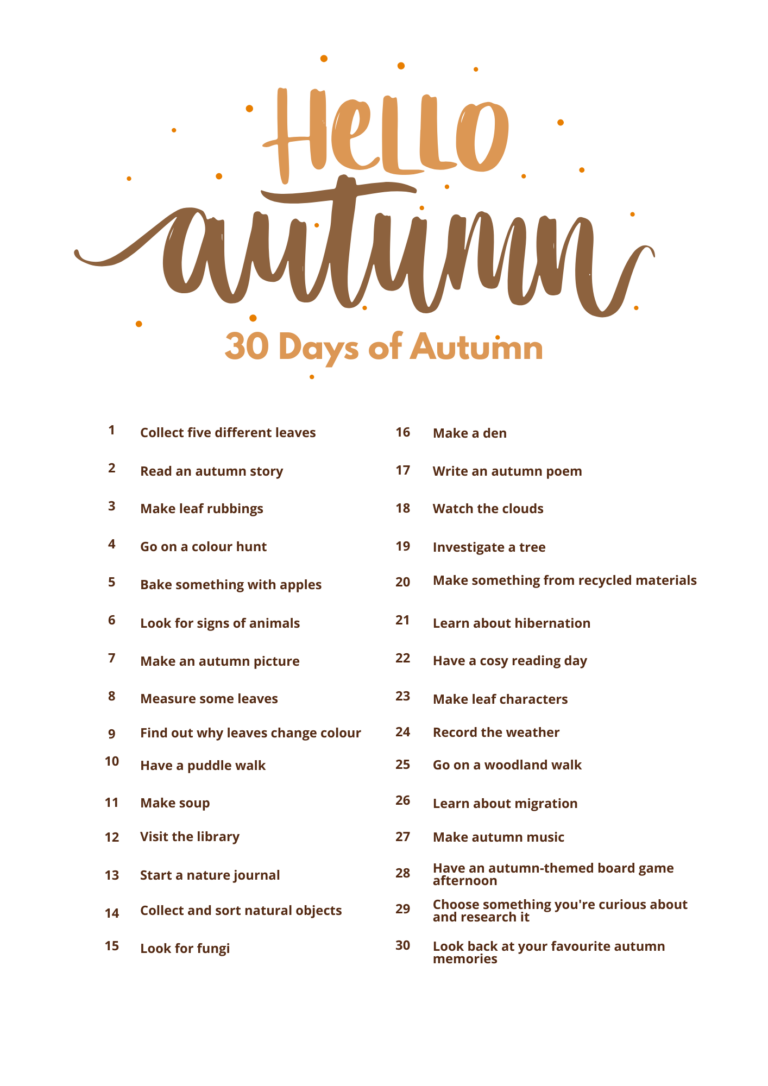
If you’re looking for a little inspiration, why not try “30 Days of Autumn”?
Choose one small activity each day. They don’t need to take long.
Day 1: Collect five different leaves
Day 2: Read an autumn story
Day 3: Make leaf rubbings
Day 4: Go on a colour hunt
Day 5: Bake something with apples
Day 6: Look for signs of animals
Day 7: Make an autumn picture
Day 8: Measure some leaves
Day 9: Find out why leaves change colour
Day 10: Have a puddle walk
Day 11: Make soup
Day 12: Visit the library
Day 13: Start a nature journal
Day 14: Collect and sort natural objects
Day 15: Look for fungi
Day 16: Make a den
Day 17: Write an autumn poem
Day 18: Watch the clouds
Day 19: Investigate a tree
Day 20: Make something from recycled materials
Day 21: Learn about hibernation
Day 22: Have a cosy reading day
Day 23: Make leaf characters
Day 24: Record the weather
Day 25: Go on a woodland walk
Day 26: Learn about migration
Day 27: Make autumn music
Day 28: Have an autumn-themed board game afternoon
Day 29: Choose something you’re curious about and research it
Day 30: Look back at your favourite autumn memories
You could do one activity every day, pick a handful that appeal to your family, or simply use the list when you’re stuck for something to do.
Download your 30 day challenge below.
The magic is in the everyday
One of the wonderful things about home education is that learning can happen almost anywhere.
You don’t need a dedicated classroom.
You don’t need expensive resources.
You don’t need to recreate school at home.
This autumn, perhaps give yourself permission to step outside, get muddy, collect leaves, ask questions, bake something, read books and follow your children’s interests.
Because sometimes the simplest autumn day can become a wonderful learning experience.
What will you be exploring this autumn? 🍁
Share your favourite autumn home ed activities, ideas and discoveries with the Home Ed Circle community – we’d love to hear them!
Comments