What if art lessons started with Bluey and Dog Man instead of Botticelli? What if children were taught to really look at the world around them, rather than draw the same sun, house and stick figure they learned when they were four?
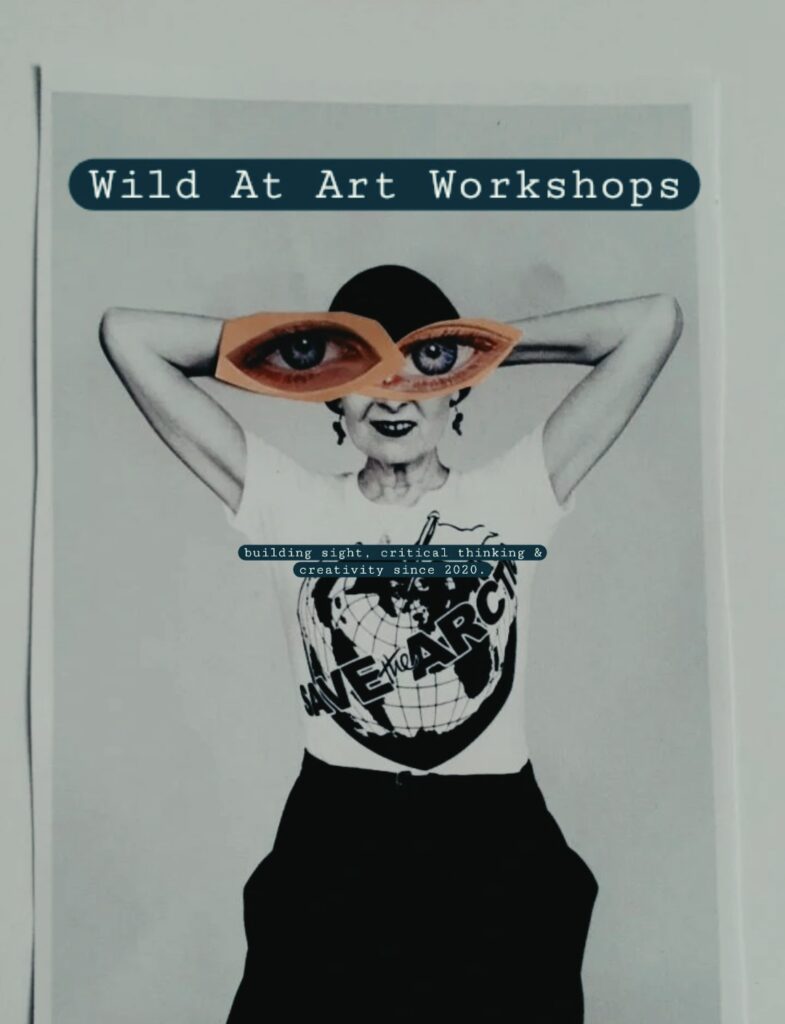
That’s the approach Niki has taken with Wild At Art since 2020. It began with busy garden gatherings of home-educated children and has grown into five in-person groups, digital learning packs, and, online sessions. Niki has no formal qualification in teaching or art, and her own children have never been to school. Her workshops mix ages on purpose, and every session comes with a story behind the art. She also has a firm belief that drawing is a graft, not a talent.
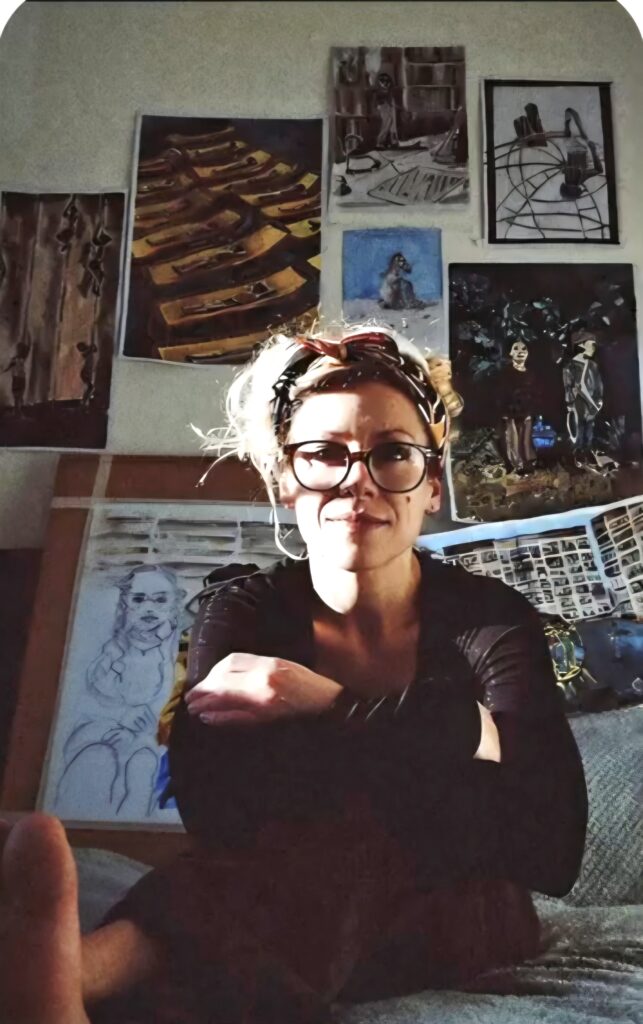
We spoke to her about why she teaches art history backwards, what she’d say to a child who insists they’re “just not good at art”, and why a good workshop should leave children with a full head and a bucket of clinking marbles.
1. Tell us a little about your family and your home education journey. What led you to start Wild At Art in 2020?
We are just a normal family of four: our two randomly turned into four, and we learned on the job. Our kids have never been near a school, so we wanted to offer them a community where they could meet children just like – or at least a little bit similar to – them. We had busy and fun gatherings of young children in our back garden back in 2019, and in 2020 we started workshops. It just made sense. I had something to offer, and I had interested and very supportive people around me, so it was an intuitive decision, just like most of my decisions. It made me push myself into new things: teaching and art, neither of which I hold a qualification in. Turns out, people actually like this aspect – real-life people who respect passion, understanding and work rather than a piece of paper. In a way, it makes me aim higher, because in some people’s eyes I always have to prove myself (like others don’t?). It not only served the children in the community, but also stood by education and the way I believe young people should be supported and educated. The idea that I could build something for them and myself from scratch excited – and still excites – me. Challenges always excite me.
2. You’ve said art education is often either missing or misses the point entirely. What did you see that made you want to do it differently?
When I first browsed through offerings of children’s workshops some time ago, I came across either totally self-led sessions, such as process art, or practical skill-building classes. It reminded me of how we teach our children times tables, but we don’t tell them why. These sessions promoted a lot of big words such as “creativity” and “confidence”, telling us those things come from the outside, not from the inside. I personally believe all of the above comes from a balanced state of mind, and a healthy diet helps as well. There is nothing new under the sun; it is our connectional thinking that puts things in a new light. I don’t give children a set piece of work to achieve, and I hardly ever make teacher examples. That only sets them up for failure. When they feel they have not achieved exactly what was set out, they automatically think it is wrong, when that is far from the truth. Or, if I don’t set goals and there is too much to choose from, they end up doing nothing. It’s like when we put the telly on and there are so many channels and programmes to choose from that we browse for a long time, then turn it off. It’s a very similar psychology: giving just enough structure. Not too much, not too little. I also felt that not giving children a detailed, fact-based, human story to go along with these projects was a mistake. Why on earth would I offer a Picasso-esque project without anecdotes and historical reference? It’s, again, knowing the times tables but being unable to put them into context. I also don’t believe in loading children with ideologies. They will find out about the ideologies when they learn the facts. When you understand the world Picasso lived in, the people who surrounded him, the past -isms of the art world, the way he worked or saw the world, and then look at his pictures, these are facts. Being one of the most wonderful artists is a claim that needs backing up. And after all, we can all build our own view on it.
3. You teach art from roughly the last 80 years first and work backwards, which is the opposite of how most of us were taught. Why does that work better for children?
I don’t only teach this era, but I certainly introduce art history through it. It is simply closer to our 21st-century visual perception. I chose the period from Cézanne to Picasso so I can explain to children why they think photographs are real, and more, why they are drawn to pictures like Bluey, Duolingo or Dog Man instead of Botticelli, Romanesque or Degas. Because photographs and screens have had a huge effect on how we see today. I love the work of Szilveszter Makó, because he doesn’t use the lens to create reality.
Art is also not a straight road with several stops. It is a web, and there are so many turns to take that will lead us down paths we never thought were connected. I prefer starting with children’s own reality and stretching back in cycles. I find it more purposeful and wholesome this way. Children find that art is part of their lives, and then learn how it has always been part of people’s lives since the beginning of time.
4. You say you teach children to see rather than to draw symbols, and that it’s the opposite of step-by-step drawing. What does that look like in a session?
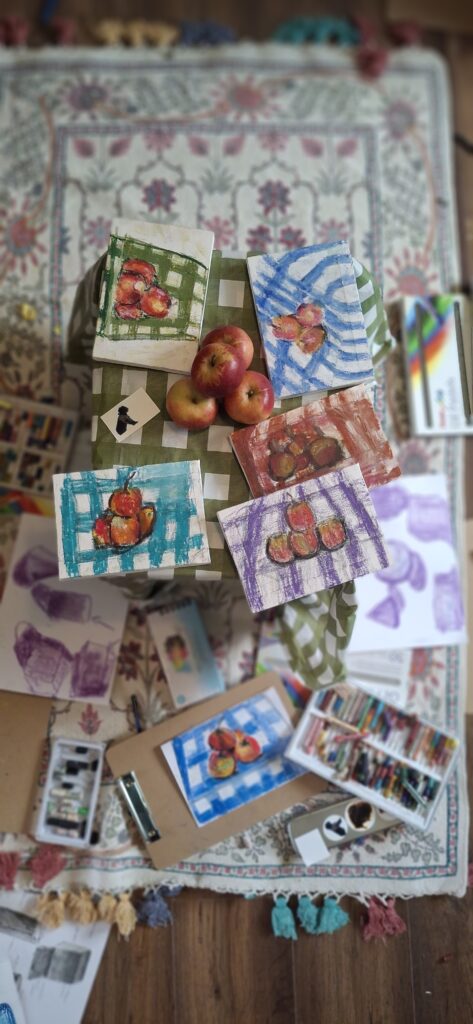
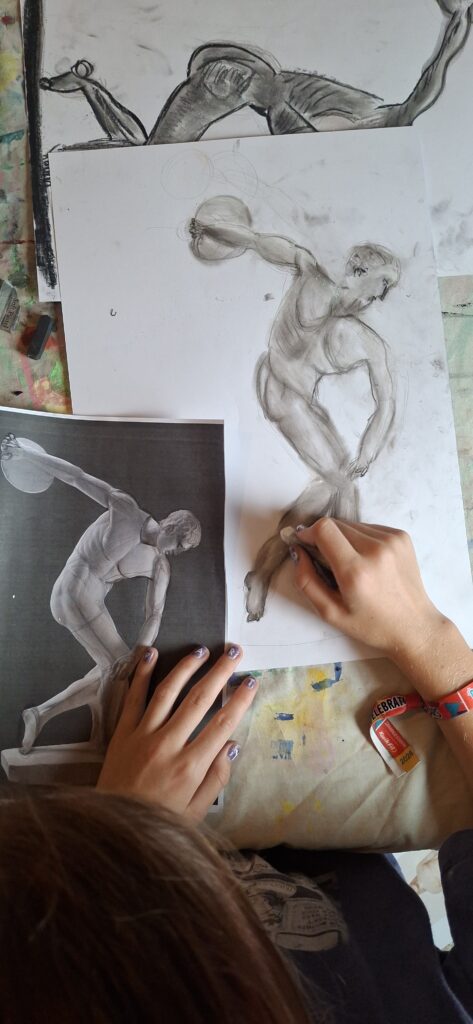
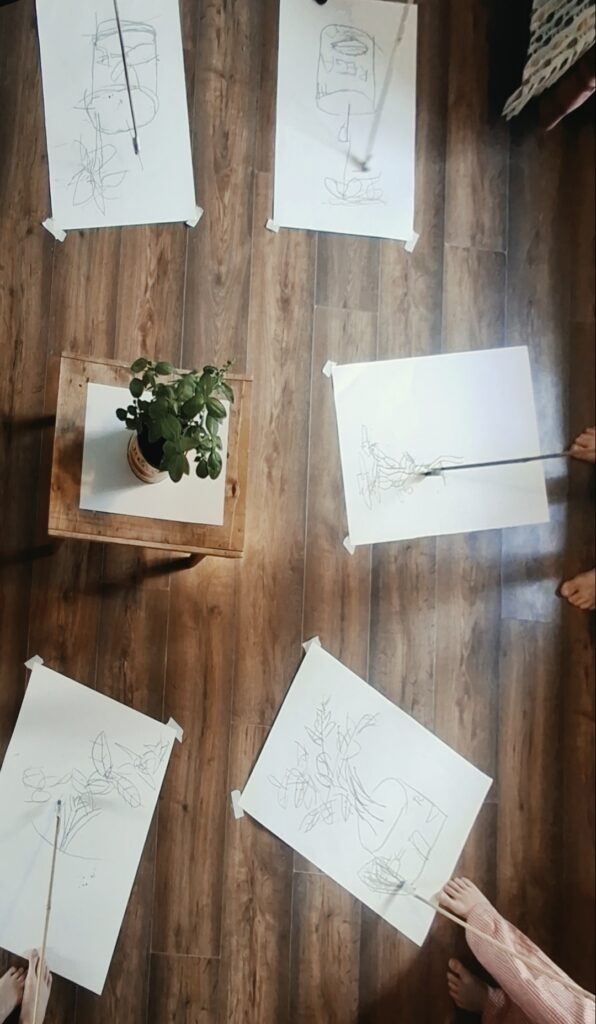
People look at photos or screens more than at each other. They walk past the same scene every day and are still unable to describe it later. People only look to get somewhere safely, not to take in what this world has to offer, or to see how it actually looks. If I were to ask someone I’d just met for the first time what colour my eyes were, they would probably struggle to remember. We don’t see actively, so naturally, we don’t gaze at paintings for hours; we just take a quick photo at the museum, then move on. If we look at the sun, it has nothing to do with the common symbol we use to draw it: a circle with straight lines around it. When I was taught how to draw a house at a very early age, I used a nice set of shapes: a square, then a triangle on top – I even added a chimney. If we really look, houses hardly have chimneys anymore. It was only a symbol; it had nothing to do with reality. Not long ago, one of my students was working on a drawing study of the Discus Thrower, and she said she couldn’t draw hands. I explained that I don’t expect her to imagine a hand from her memory bank that will fit the structure well. I simply want her to open her eyes, actively look at what is in front of her, and draw that. Big difference. I also find some children struggle to separate depth and flatness. Then comes the process of translating the 3D world into a 2D drawing, which has many unsolvable problems. And with the problems come the many curious and exciting ways humans have tried to solve them. Most people draw from photos, which I am not against whatsoever. But drawing from life is a completely different thing, especially once we first learn to recognise and see what life looks like.
5. You describe drawing and painting as “a graft, not a talent.” What would you say to a parent whose child insists they’re “just not good at art”?
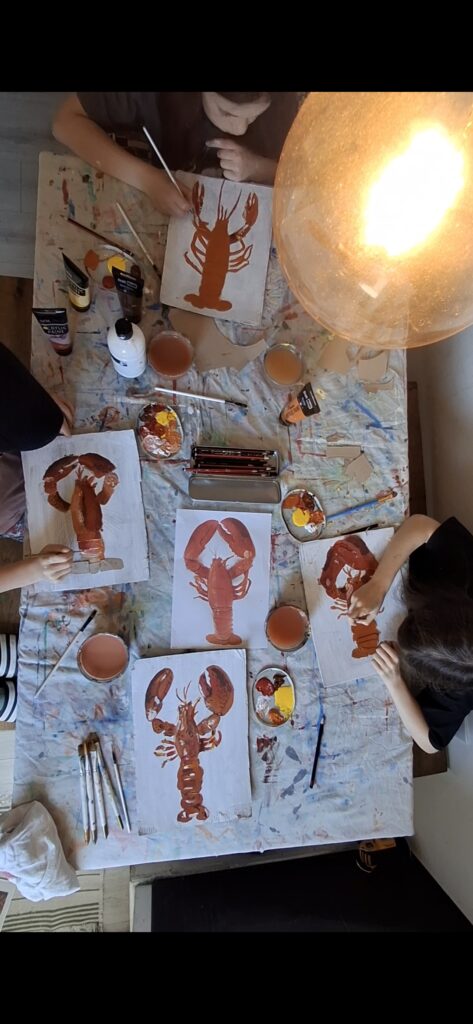
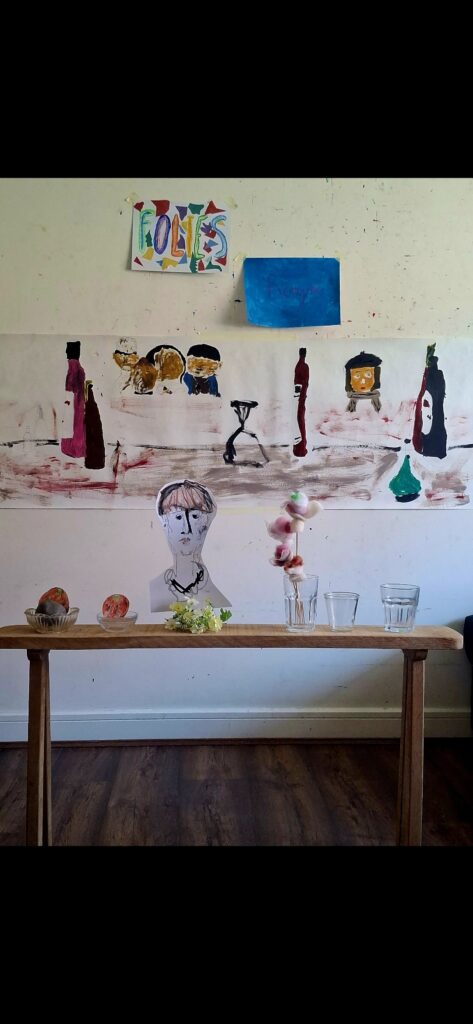
I would say that parents know their children best. But saying you’re “not good at something” without giving it a proper go is just a claim, not a fact. Maybe they just need a different light on the topic, like I did when I was struggling with mathematics some years ago. Visualising and drawing made things crystal clear, and it turned out it wasn’t maths’ fault I was not so good at it. It’s the same with reading: there is nothing wrong with reading; you just need to find the right book. If we are truly honest with ourselves, labelling successful people “talented” or “lucky” is an easy excuse not to even try. But in reality, we are very quick to want astonishing results without wanting the work that goes with them. People are jealous of what they don’t have, but they are not jealous of what it takes to get there. We can ask all the masters how much work they put into their pieces, and we quickly realise that it’s a bigger amount than we want it to be. And with art and graft comes self-discipline – nobody was standing behind Hockney with a whip telling him to get on with those iPad paintings.
6. Debate and discussion are a big part of your workshops. Why does talking about art matter as much as making it?
You see, I am not against school. Quite the opposite. “School” comes from the Greek scholē, which means “free time”: free time from physical labour. The Greeks believed that the best way to spend your free time was to engage in deep conversations, debate ideas, dwell in intellectual discussions and grow your mind. School became the place for this exercise, a place to learn how to learn, a place for curiosity. In this ancient sense of the term, I hold schools in high regard; the problem was never with that. Our personal problem was the methods and agendas that hid behind the institution, and that’s why we decided to home educate (or homeschool, not in the legal but in the true sense of the word).
7. Your groups are small and mix ages from around 9 to 16. How does that work, and what do the older and younger children each get from it?
Ages vary a lot in every workshop, but with care and balance. I like to drop in one or two young ones (8–9) with the older ones (10–13), simply because this feels more natural and lifelike to me. They invisibly learn how to talk to different ages with care and respect. I like how the little ones feel proud being with the big kids, taking on focus and self-discipline, and learning a great attitude. The older children then get experience in leadership and guidance, which some of the girls just love – you can see their protective, mothering side come out. Once the balance tips, however, it can quickly descend into uncontrollable mayhem, where the little ones want to take over and the big ones feel left out. But I am pretty strict about it, and I regularly have to turn children away from sessions purely because their ages and development wouldn’t fit the group dynamics.
8. Walk us through a typical workshop. What would a child experience from arriving to leaving?
A full head, for sure. I only see children once a week or once a fortnight, so I always tell them to make our time together count. They can do whatever they want for the rest of the day or week, but we are here for a purpose. The purpose is to leave with one single thing they didn’t know before they came through my door. They don’t have to remember everything, just pick the one thing that relates to them the most and take it home with them. I like to call these marbles in a bucket, the bucket representing their heads. You can imagine the number of marbles by the end of a few months or years. Then the goal, through all of these debates and discussions, is to move the bucket (think) and make the marbles clink. I love noisy workshops with a lot of clinks.
On the practical side, the second part of each session is giving children a set of concepts they can take wherever they want – within a fine boundary. These are very often not finished projects, and you can imagine how disappointed parents can be. But the fact remains that I am not there to force something down the children’s throats, but to help them grow their style, while I make sure they have a good understanding of what we are meant to be doing, with support to push through even if it seems dry, boring or too overwhelming. Breaking projects down into digestible and logical concepts is not the same as step-by-step drawing.
9. Can you share a moment from a workshop that’s stayed with you – a child who surprised you, or something that clicked?
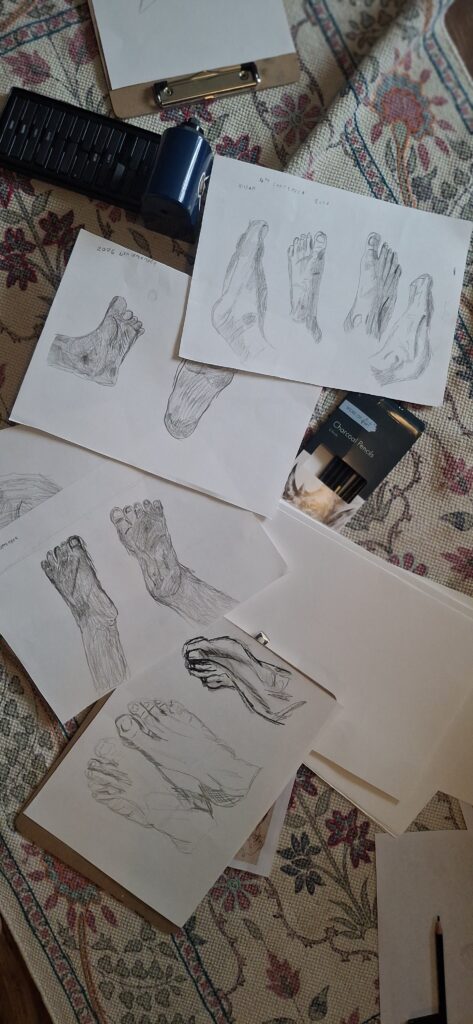
They surprise me all the time. Sometimes with their attitude, sometimes with their ideas, sometimes with their humour. I still remember holding a three-year-old under my arm while I was instructing four other children under seven on a project. It was mayhem. My own son actually surprised me the other day while he was doing a study of Francis Bacon’s Self-Portrait. He said he could see how Bacon might have felt back in post-war London. The little ones come out with the most honest ideas, as they don’t have the concept of expectations being put on them. And I just love a six-year-old drawing Lucian Freud’s zebra with all the focus in the world, getting the values right, and then the smile they give when I suggest putting a horn on it.
10. Tell us about your subscription and digital learning packs. How do families typically use them at home?
The packs take a lot of self-discipline too. Without someone standing behind you telling you what to do, how and when, the packs are very self-paced. I’ve filled all the resources with plenty of ideas, and some families find them quite overwhelming until they settle into a pace, which might take longer than expected. But they are fun.
11. For a parent who feels completely unconfident about teaching art, where would you tell them to start?
Look with both eyes, just like Hockney said. Model behaviour that is rich in curiosity, work and questions. Or trust someone else with the role. That’s why my kids have music tutors and jiu-jitsu coaches.
12. What’s next for Wild At Art, and where can families find you, book a workshop or try a freebie?
After six years of working with five in-person groups, I have come to a time and space in my life where I am able to offer two brand-new ones: one for little ones (ages 7–10) and another for my usual age group, 10–16/18. I am very excited about them, as no matter what I plan, the dynamics and whole lessons change based on who I actually work with. I have always been like that – I continuously change topics, methods, mediums and so on, because as I learn about my students, I learn what they need.
And on top of that, I have launched online sessions. Bookings are now open, email to secure your spot. This is a very new challenge for me, and I am incredibly excited and anxious at the same time. I rattle on a lot, and with my accent, I always worry whether the message gets through. But in all honesty, it has always got through one way or another. These online sessions will offer lots of practical exercises that will make us laugh and get annoyed at the same time. I will work with students in real time on projects I have never done before, because I want us all to push ourselves and have fun, have a laugh, see how it’s done, and learn from each other. Just because I’m more experienced doesn’t mean I don’t learn on the job, and it certainly doesn’t mean I’m the best at it. I very often tell my students that I expect them to be at the same level as me, or even better, within six months if they commit to the journey.
Niki Balazs, Wild At Art Workshops
www.wildatartworkshops.co.uk
IG @wildataartworkshops
FB @wildatartworkshops
Email wildatartworkshops@gmail.com
Comments